
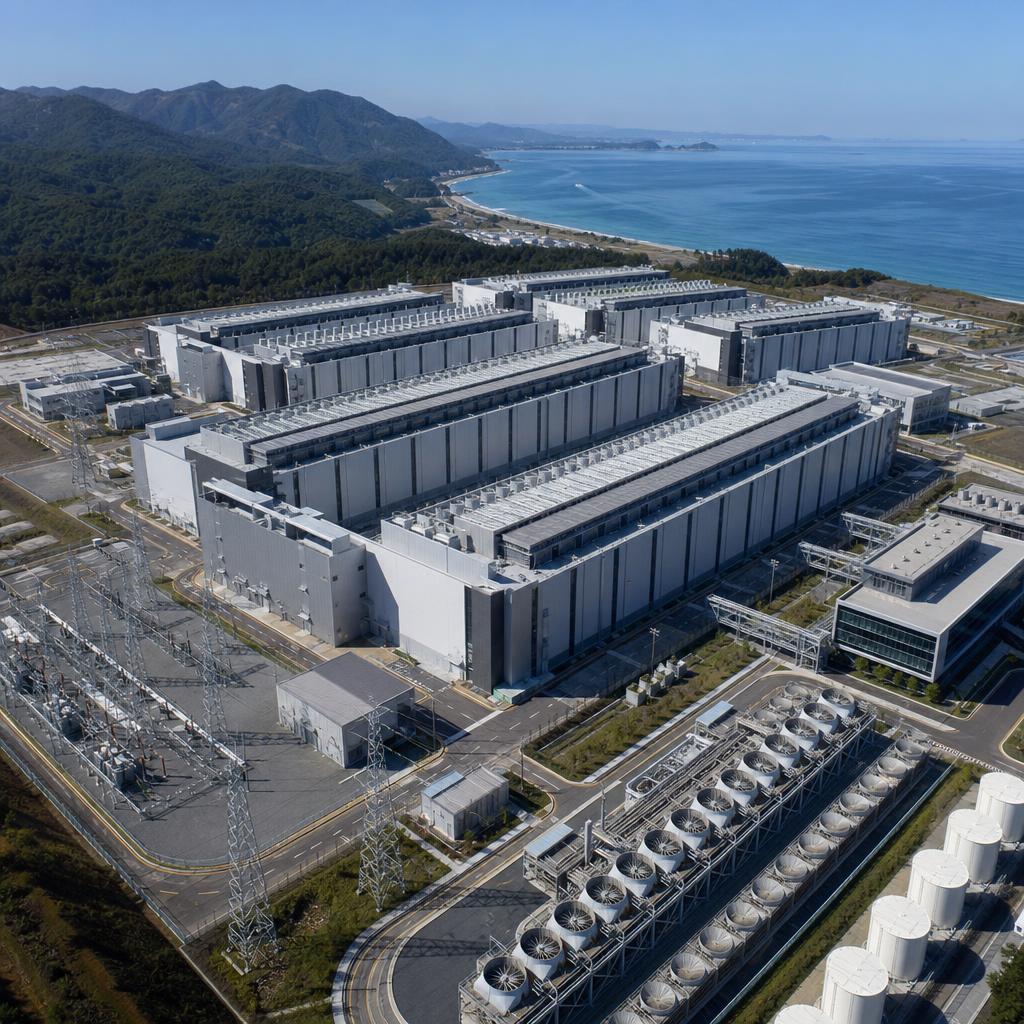
Why is the investment attraction for the AI data center in Donghae, Gangwon-do attracting attention?
Gangwon Province, Donghae City, and GS have taken the first step toward attracting over 100 trillion won in AI infrastructure investment by signing an agreement to establish a large-scale AI data center in the Donghae region. The key point is the goal of establishing Asia's largest single AI data center campus with a total capacity of 2.4 GW by 2029. This can be viewed not merely as the construction of a new building, but as a mega-project where power, cooling, telecommunications, cloud services, and the local industrial ecosystem operate in unison.

This agreement is drawing particular attention because the center of AI competition is rapidly expanding from algorithms and services to infrastructure. Fields such as generative AI, large-scale language models, autonomous driving, smart manufacturing, and bio-data analysis require massive computing power and a stable power supply. Data centers are the physical foundation that actually performs these computations and are key facilities that determine the growth speed of the AI industry.
The Donghae AI Data Center project is still at the starting line of attracting investment through agreements. Therefore, details such as the final project cost, participating companies, specific site, power procurement methods, and licensing schedule are highly likely to be finalized through future procedures. However, even based on the direction disclosed so far, this is a matter that could bring about significant changes to the AI industry in the Gangwon region and the landscape of domestic AI infrastructure.
- Key Participants: Gangwon-do, Donghae-si, GS
- Business nature: Creation of a massive data center campus to meet AI computing demands
- Investment scalePursuing investment attraction worth hundreds of trillions of won
- Target scaleTotal 2.4GW data center infrastructure
- Target timePhased development plan by 2029
- Policy significanceThe Intersection of Strengthening AI Industry Competitiveness and Balanced Regional Development
The Significance of Asia's Largest 2.4GW Data Center Campus
MW and GW are units that frequently appear when discussing the scale of data centers. 1 GW is equal to 1,000 MW, and in a data center, this figure is directly related to the power capacity available to the facility. AI data centers consume significantly more power than general data storage centers because they have a higher proportion of GPU servers and high-performance cooling equipment.
A total capacity of 2.4GW is a very large scale for a single campus. This does not simply mean having a large number of server rooms; it implies that large-scale power infrastructure, cooling systems, communication networks, security systems, and operational personnel must be in place. To reliably perform AI model training and inference, the sustainability and efficiency of the entire infrastructure become more critical than the performance of a single server.
| 구분 | General data center | AI Data Center |
|---|---|---|
| Main purpose | Web services, storage, backup, general cloud operations | AI learning, inference, super-high-performance computation processing |
| core equipment | CPU servers, storage, network equipment | GPU, AI accelerator, high-speed network, high-density server |
| 전력 수요 | Relatively low or medium level | Very high |
| Cooling importance | Important but relatively standardizable | High-density thermal management is a key competitive advantage |
| Regional impact | Focus on employment, real estate, and telecommunications network improvement | Linkage between AI industry, power grid, advanced manufacturing, and R&D is possible |
To realize a 2.4GW scale, constructing data center buildings alone is insufficient. A stable transmission network, substations, backup power, cooling water or alternative cooling technologies, ultra-high-speed communication networks, cybersecurity, and operational automation systems must be established alongside it. For this reason, this project is closer to the creation of an AI infrastructure industrial complex than a simple construction project.
Why AI Data Centers Connect to Power Infrastructure
AI computations perform large-scale parallel processing. As numerous GPUs operate simultaneously, they consume massive amounts of electricity and generate significant heat. Unstable power increases the risk of server failures and data loss, while insufficient cooling can reduce equipment efficiency and lifespan.
Therefore, the following conditions are considered important when selecting a location for an AI data center.
- Whether large-scale power can be supplied stably
- Whether it is possible to expand the power grid and construct substation facilities
- Whether there are natural environmental or technical conditions that can increase cooling efficiency
- Whether the communication infrastructure connecting to domestic and international networks is sufficient
- Is it possible to secure land, obtain permits, and conduct an environmental impact review?
The attention surrounding the AI data center in Donghae, Gangwon Province, can be attributed to a combination of factors, including the industrial base of the East Coast region, the potential for utilizing energy infrastructure, the availability of a large site, and policy trends aimed at alleviating concentration in the Seoul metropolitan area. However, its actual competitiveness will be evaluated based on future power supply plans, operational efficiency, and the ability to secure tenant demand.
What changes could occur in the AI industry in the Gangwon-do region?
Gangwon Province has grown based on diverse local industries, including tourism, biotechnology, medical services, energy, logistics, and agri-food. The establishment of a massive AI data center in this region could strengthen the foundation for connecting existing industries with digital technologies. In particular, there is a possibility that demand for related industries, such as data processing, cloud computing, AI service operations, security, power management, and cooling technology, will increase.
From a regional economic perspective, the effects of a data center can be divided into two stages. The first involves the demand for civil engineering, electrical services, facilities, equipment delivery, logistics, accommodation, and food and beverage services generated during the construction phase. The second involves the effects that emerge during the operation phase, such as the recruitment of specialized personnel, maintenance, security monitoring, network operations, and the attraction of data-driven companies.
Expected regional ripple effects
- Attracting high-tech infrastructureThe establishment of large data centers could lead to active discussions on improving communication and power grids.
- Expansion of the corporate ecosystemThere is a possibility that cloud, AI solution, security, and equipment maintenance companies will gather in the vicinity.
- Creating a jobIn addition to short-term jobs during the construction phase, specialized jobs in the fields of operations, security, facilities, and networks may arise.
- Linkage with local universities and research institutionsAI talent development, industry-academia collaboration, and research utilizing data can be expanded.
- Industrial advancementIt becomes easier to integrate AI analysis and automation technologies into existing industries such as manufacturing, port logistics, tourism, and healthcare.
However, the establishment of a data center does not automatically guarantee the growth of the local AI industry. Data centers are infrastructure; companies and talent capable of building actual services on top of them are required. Therefore, to foster the AI industry in Gangwon-do, concrete programs that connect data centers with local companies, universities, and public institutions are crucial.
Strategic opportunities that the East Sea region can gain
Donghae City is a hub city on the East Coast equipped with ports and industrial infrastructure. If a large-scale data center is established, logistical advantages can be highlighted in areas such as equipment delivery, power facilities, cooling systems, and the supply of maintenance parts. Furthermore, as competition for data center locations centered in the Seoul metropolitan area becomes saturated and the burden on power supply increases, the need for a hub outside the capital region is also growing.
For the region to benefit in the long term, strategies beyond simple site provision are required, such as the following.
- Development of AI, Cloud, and Electrical Equipment Training Courses for Local Talent
- Designing a cooperation structure between data center operating companies and local SMEs
- Connecting AI demonstration projects with the tourism, port, medical, and disaster safety sectors
- Establishing eco-friendly operating standards utilizing renewable energy and high-efficiency cooling technology
- Transparent information disclosure and communication to enhance resident acceptance
Ultimately, the success of this project depends on connectivity rather than scale. While the figure of 2.4GW itself is important, tangible regional growth effects will materialize when that infrastructure leads to local industries, education, attracting businesses, and innovating public services.
The Intersection of GS Mega Projects and Government AI Policy
The concept for the AI data center in Donghae, Gangwon Province, is significant in that it is a mega-project in which GS is participating. Large-scale data center projects require massive capital, an understanding of power and energy, long-term operational capabilities, and experience in complex development. Therefore, a structure in which a major private corporation collaborates with a local government can serve as an important foundation for the project's implementation.
The competitiveness of the AI industry is no longer determined solely by software development capabilities. Securing high-performance semiconductors, cloud infrastructure, data center power efficiency, network latency, security certifications, and eco-friendly operational capabilities are all part of this competitiveness. As the government simultaneously pursues strengthening AI industry competitiveness and balanced regional development, the Donghae Project can be viewed as an example where national strategy meets regional development.
| aspect | Benefit | Tasks to check |
|---|---|---|
| National AI competitiveness | Strengthening the foundation for AI services and research by securing large-scale computing infrastructure | Attracting actual AI companies and securing demand for stable operations |
| balanced regional development | Formation of high-tech industrial hubs in non-metropolitan areas | Recruiting local talent and building a cooperative ecosystem |
| energy industry | Increased demand for power grid, cooling, and energy management technologies | Power supply stability and eco-friendly transition |
| private investment | Possibility of attracting long-term investment worth 100 trillion won | Business feasibility, financial structure, and phased investment confirmation |
Why is investment in AI infrastructure important right now?
Recently, the competition in AI has expanded from model development to securing infrastructure. Training AI models requires numerous high-performance chips and massive power, while stable data centers are necessary to rapidly process user requests during the service phase. Without sufficient infrastructure, service expansion becomes limited, even with superior technology.
Demand for AI data centers is highly likely to continue increasing in Korea as well. This is due to the widespread adoption of AI in the public sector, corporate business automation, predictive maintenance in manufacturing sites, medical image analysis, financial risk management, and content creation services. If domestic infrastructure can accommodate this demand, it offers advantages in terms of data sovereignty and security.
The Practical Significance of GS Participation
The participation of GS, a private entity, can be interpreted not merely as a brand effect, but in terms of driving business momentum. A mega-data center is a complex project that combines real estate development, energy procurement, facility operation, investment attraction, and partnership management. The feasibility of the project increases when the financial and operational capabilities of a private company align with the administrative support and regional development strategies of the local government.
Of course, the signing of an agreement does not immediately signify the final confirmation of the investment. Future steps, including business feasibility studies, power supply consultations, environmental impact assessments, gathering of resident opinions, licensing procedures, and financing structures, must be verified in stages. Therefore, when interpreting investment news, it is necessary to maintain a balanced perspective that examines feasibility alongside the expected benefits.
Challenges that must be solved for success
Given the significant scale and symbolic importance of the Donghae AI Data Center project in Gangwon Province, there are numerous challenges to overcome. In particular, energy and environmental issues are critical, as AI data centers are facilities that consume a large amount of electricity and emit significant heat. Communication with local residents, long-term operating costs, and securing actual customers are also important variables.
1. Power Supply and Grid Stability
A 2.4GW data center campus is based on very high power demand. To operate a facility of this scale stably, the expansion of the transmission network, substation capacity, reserve power, and power quality management are essential. If the power supply plan is unclear, it can affect the project schedule and operational stability.
2. Eco-friendly Operation and Cooling Technology
Since AI servers generate high heat, cooling costs can account for a significant portion of total operating expenses. Various technologies, such as air cooling, water cooling, and immersion cooling, can be considered, and a design that enhances energy efficiency is crucial. Furthermore, eco-friendly operational standards, including the utilization of renewable energy, waste heat recovery, and water usage management, also influence local acceptance.
3. Actual Occupancy Demand and Business Model
The success of large-scale data centers depends not on facility size, but on securing customers. They must possess price competitiveness and stability that allow global cloud companies, domestic AI firms, public institutions, research institutes, and financial and manufacturing companies to actually utilize them. Network latency, security certifications, and the level of operational personnel are also important criteria for securing demand.
4. Communication with the local community
While large-scale development projects can benefit the local economy, they can also be accompanied by anxiety among residents. This is because concerns may be raised regarding electromagnetic waves, noise, heat emissions, increased traffic volume, and environmental impacts. Trust can be built only when objective data disclosure, public briefings, mutual cooperation agreements, and local employment plans are established together.
5. Talent Development and Industry Linkage
Operating AI data centers requires a diverse workforce specializing in fields such as electrical engineering, mechanical engineering, cooling, networking, security, cloud computing, and automation operations. Unless local universities and vocational training institutions collaborate to cultivate talent, reliance on external personnel may increase. To achieve the goal of fostering the local AI industry, it is crucial to establish channels through which local talent can participate in projects.
| Key Tasks | Why it matters | Necessary response |
|---|---|---|
| Securing Power | The most basic condition for AI data center operation | Review of power grid expansion, backup power, and long-term supply contracts |
| Cooling efficiency | Direct impact on operating costs and equipment stability | High-efficiency cooling technology, waste heat utilization, water usage management |
| environmental impact | Impact on resident acceptance and permits | Environmental review, transparent information disclosure, eco-friendly design |
| Securing demand | The core of long-term business viability | Attracting cloud and AI companies, securing security certifications, and securing price competitiveness |
| 지역 연계 | The effect of balanced regional development determines | Talent development, local business participation, industry-academia cooperation programs |
Therefore, it is difficult to evaluate this project based solely on rosy prospects. While the symbolic significance of a 100 trillion won investment in AI infrastructure is great, very realistic verification is required during the implementation phase. Conversely, if these challenges are systematically addressed, the East Sea can establish itself as a key hub in the domestic AI infrastructure map.
Frequently Asked Questions (FAQ)
Q1. What exactly is the Gangwon-do Donghae AI Data Center project?
This is a project in which Gangwon Province, Donghae City, and GS are collaborating to establish a massive AI data center campus in the Donghae region. The goal is to build Asia's largest single AI data center infrastructure with a total capacity of 2.4 GW by 2029. It is appropriate to understand the current stage as having taken the first step toward attracting over 100 trillion won in investment through this agreement.
Q2. Why is the 2.4GW scale important?
GW is a unit representing power capacity and is an important criterion for judging the scale and operational feasibility of AI data centers. 2.4 GW signifies a very large infrastructure capable of handling large-scale AI computations. However, for this scale to become a reality, power supply, cooling, communication networks, licensing, and investment procurement must all be supported.
Q3. What are the advantages for local residents?
During the construction phase, economic effects can be generated in local construction, logistics, accommodation, and food and beverage sectors, while the operation phase can create specialized jobs in fields such as electrical engineering, machinery, security, and networking. Furthermore, linking AI-related companies with educational programs can contribute to the advancement of local industries. However, to maximize actual benefits, concrete plans for local employment and mutual growth must be established.
Q4. Don't data centers cause environmental problems?
Due to the high power consumption and cooling demands of AI data centers, their environmental impact must be thoroughly reviewed. Low energy efficiency can lead to increased carbon emissions, and water usage can also become an issue depending on the cooling method. Therefore, responses such as the utilization of renewable energy, high-efficiency cooling, waste heat recovery, and the disclosure of environmental information are crucial.
Q5. Does this agreement mean the project is immediately confirmed?
While the signing of the agreement marks an important starting point for the project, it does not mean that the final investment and groundbreaking are fully confirmed. Moving forward, feasibility studies, power supply negotiations, site selection and permitting, environmental reviews, financing, and securing tenant demand must proceed in stages. Therefore, along with anticipation, it is necessary to calmly monitor future progress.
Conclusion: The Donghae AI Data Center is a testbed for regional and national AI competitiveness.
The Donghae AI Data Center project in Gangwon Province is a matter worthy of significant attention based solely on the three keywords: a 100 trillion won investment in AI infrastructure, Asia's largest 2.4GW data center, and a GS mega-project. However, the more important essence lies in the question of where and how Korea will build the physical infrastructure necessary for the AI era.
For this project to succeed, conditions such as securing large-scale power, eco-friendly cooling, actual customer demand, fostering local talent, and ensuring community acceptance must be met simultaneously. When designed to go beyond simply attracting data centers and instead foster the AI industry in the Gangwon region, Donghae can become a leading example demonstrating both AI infrastructure and balanced regional development.
AI Summary : Gangwon Province, Donghae City, and GS have laid the groundwork for attracting over 100 trillion won in AI infrastructure investment through an agreement to build the Donghae AI Data Center. The goal is to establish Asia's largest data center campus with a total capacity of 2.4 GW by 2029, and its success depends on power, cooling, securing demand, and regional connectivity. This project is a significant mega-project that simultaneously tests the fostering of the AI industry in the Gangwon region and the strengthening of national AI competitiveness.
In conclusion, the Donghae AI Data Center in Gangwon Province is a large-scale project in its early stages with many hurdles to overcome; however, if implemented as planned, it could become a turning point that reshapes the landscape of domestic AI infrastructure. Moving forward, it is important to focus on the specificity of the implementation plan, mutual growth with the local community, and a sustainable operational model, rather than the scale of the investment.
