
The Necessity of AI and Ground Subsidence Prediction
Recently, ground subsidence accidents have been occurring frequently due to climate change and urbanization. This problem is particularly serious as it can lead to casualties, going beyond mere economic losses. In particular, since sinkholes are difficult to predict and appear suddenly, there is an urgent need for technology to prevent them. Against this backdrop, AI-based ground subsidence prediction technology is gaining attention, and an innovative approach combining GPR (Ground Penetrating Radar) and GIS (Geographic Information System) is becoming the key to solving this issue.
AI demonstrates exceptional capabilities in analyzing vast amounts of data to identify patterns and predict future conditions. Therefore, AI-based ground subsidence prediction technology can provide highly reliable, data-driven results, which is directly linked to public safety. In particular, the GPR and GIS integrated model offers the potential to evaluate ground conditions in a more precise and efficient manner than existing physical exploration techniques.
Advantages of GPR non-destructive exploration
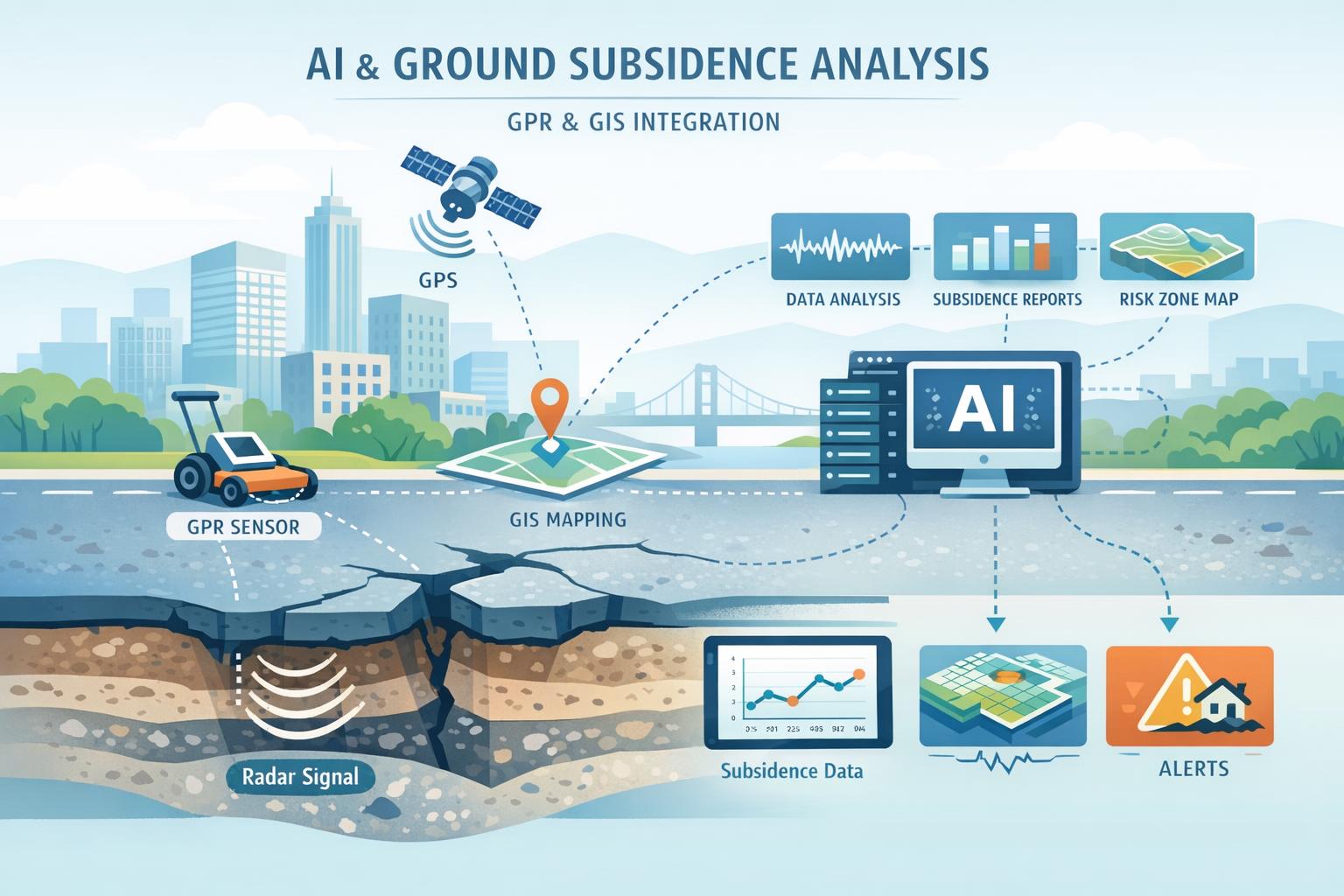
GPR (Ground Penetrating Radar) is an innovative technology that enables the exploration of underground structures using a non-destructive method. This method utilizes electromagnetic waves to detect subsurface irregularities, allowing for the identification of various soil and rock characteristics. GPR plays a particularly important role in sinkhole prevention.
One of the greatest advantages of GPR is its speed and accuracy. Compared to traditional drilling methods, data can be acquired in significantly less time and at a lower cost, and results can be obtained in real time. Furthermore, this data can be analyzed by AI algorithms to create more sophisticated predictive models. This integrated approach will make a significant contribution to proactively preventing the potential occurrence of sinkholes in the future.
The combination of AI and GPR technology is not limited to mere data analysis. They interact with each other to create a continuously improving system. In other words, when an AI model based on initial data learns from new data and updates its information, it becomes capable of making more accurate predictions.
Effects of the GIS linkage model
GIS (Geographic Information System) is a powerful tool for managing and analyzing spatial information. By visualizing and analyzing various environmental variables, it provides significant assistance in policy decision-making and risk management. AI-based GIS-linked models utilize data obtained from GPR to enable more sophisticated analysis and prediction capabilities.
In urban areas in particular, ground subsidence is highly likely to occur due to the complex interplay of various factors. GIS possesses the capability to analyze these complex factors by considering them in an integrated manner. Furthermore, through map-based visualization, it contributes to establishing a rapid response system by enabling relevant agencies to share information and collaborate more easily.
For example, by linking historical sinkhole data with current ground condition information measured by GPR in a specific area, potential future risks can be identified in advance. This advanced system will bring economic value not only to public safety but also to local communities and businesses.
Future Outlook and Conclusion
The combination of AI-based ground subsidence prediction technology with GPR and GIS is expected to advance further in the future. It is highly likely to be utilized in various fields, and will become an essential element, particularly in the construction and urban planning sectors. As data processing capabilities improve alongside the development of the latest AI technologies such as deep learning, more detailed and accurate risk assessments will become possible.
The era of sinkhole prevention is just around the corner! We look forward to these innovative technologies contributing to the creation of a safe urban environment and transforming our lives. We hope that new research and development will continue in this rapidly evolving field to help protect more lives and property.
