
If you want to reduce advertising costs when creating a dermatology website, you must start by examining the site structure.
There are dermatology clinics where advertising costs continue to rise, but consultation inquiries are not increasing as much as expected. Particularly in highly competitive industries like dermatology, the structure is such that stopping advertising easily leads to a decrease in website traffic as well.
The problem is not the advertisements themselves, but rather that the website often fails to properly accommodate the visitors who arrive through them. To use a simple analogy, it is similar to continuously pouring water into a container that has many small holes at the bottom.
Therefore, creating a dermatology clinic website is not simply about making a screen to introduce the clinic. It is closer to the task of building a website that retains visitors from advertisements, accumulates traffic from search engines, and reduces long-term dependence on advertising .
1. A website that reduces advertising costs is not a landing page that is used once and then discarded.
Creating a separate landing page for an advertising campaign can help secure short-term inquiries. However, if you stop the ads, visitors to that page may also decrease.
Conversely, the situation changes if the entire website is designed with search and content in mind. As pages explaining patients' concerns and treatment areas—such as acne, pigmentation, lifting, and hair removal—are accumulated one by one, the website itself can become a foundation for search traffic.
For example, the acne page explains the types of acne, what is checked during consultation, differences in treatment methods, care instructions, and frequently asked questions, while the pigmentation and lifting pages also cover their respective topics in depth.
The content created in this way remains on the homepage even after the advertisement ends. It differs from short-term landing pages in that it can continue to be utilized as an information asset for search engines and AI to discover the page.
Advertising generates traffic, and website content should play the role of accumulating that traffic and information as assets.
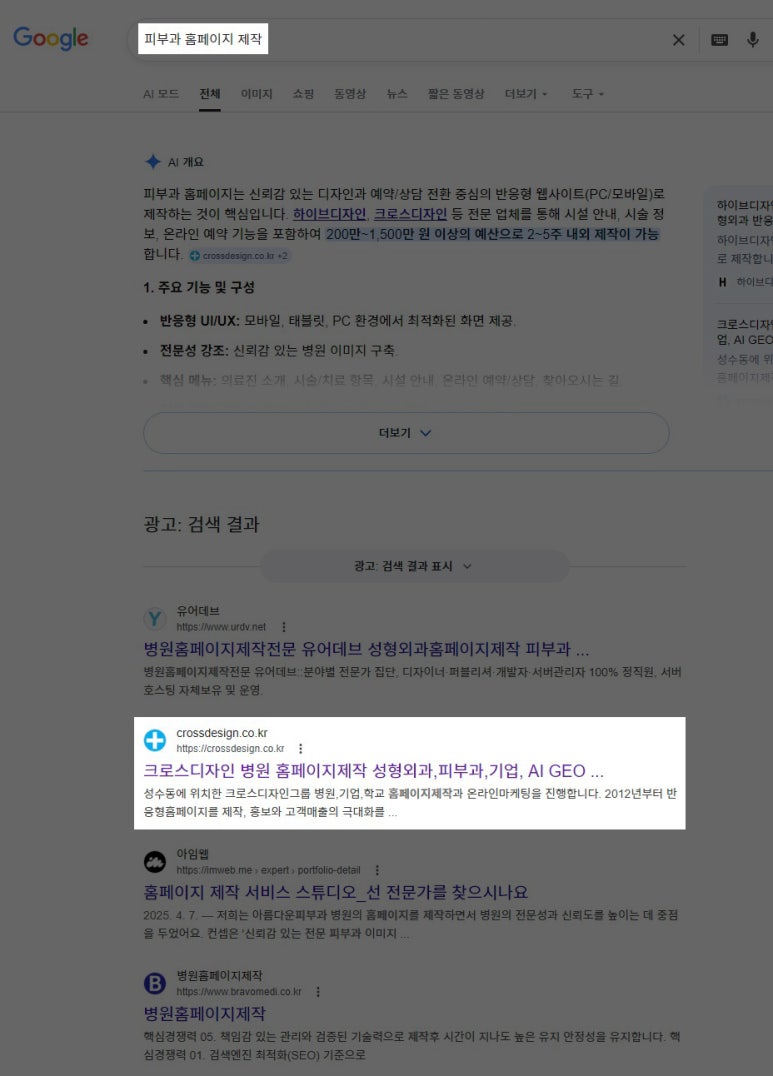
2. What is more important than the ad click is 'what happens after the click'.
Users who click on an advertisement and visit the website evaluate a hospital faster than expected. Within a short amount of time, they check whether the procedure they are looking for is available, whether the medical staff and the hospital are trustworthy, and where they can consult.
However, if the first screen contains only stylish images and event banners, and key treatments, medical staff, consultation methods, location, and FAQs are not clearly displayed, it is difficult for visitors to proceed to the next step.
The role of advertising is limited to driving traffic to the website. The website is responsible for converting actual visitors into inquiries and reservations.
A good website should not simply welcome visitors, but naturally guide them to their next action.
Ad Entry → Check Procedure Information → Verify Trust in Medical Staff and Hospital → Check FAQ → Consultation or Appointment
This flow must be clear so that the value of a single visitor can be increased even when using the same advertising budget.
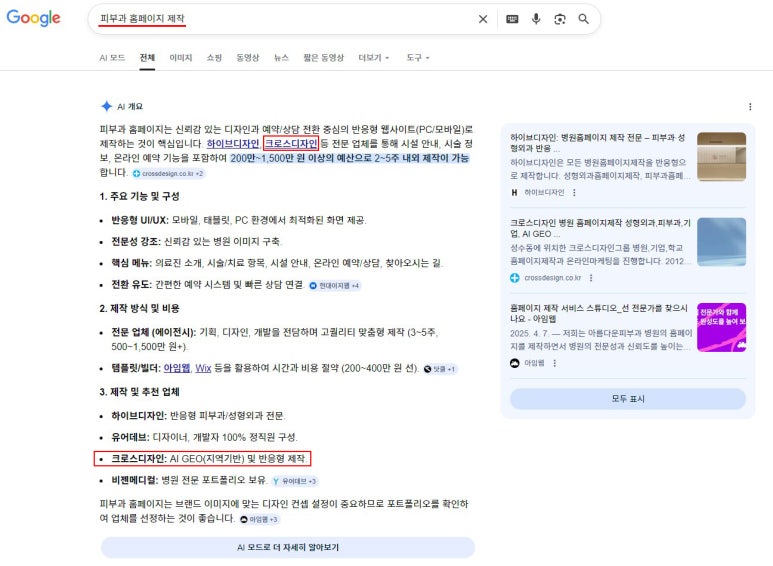
3. To reduce reliance on advertising, a structure is needed where search traffic accumulates.
If you want to reduce the burden of advertising costs, you need to gradually build up traffic sources other than advertisements. To achieve this, it is important to have a website structure that allows search engines to read and understand the actual content, rather than one dominated by monolithic images.
For example, it would be good if the following information were clearly organized on the pages for each procedure.
· What the procedure is
· What concerns do you seek counseling for?
· Where to apply
· How the counseling process proceeds
· What the general recovery process is like
· What are the precautions before and after the procedure?
· Frequently Asked Questions
· Related medical staff
· Consultation and Reservation Methods
Users find it easier to find the information they need, and search engines also find it easier to identify the topic of each page.
If SEO is the process of making a website easy for search engines to discover and understand, GEO and AEO can be seen as a direction where generative AI understands the relationship between the hospital and its content and structures it to effectively answer user questions.
Ultimately, the important thing is not to add SEO, GEO, and AEO as separate functions, but to organize the hospital's actual information in a way that is easy for both people and search systems to understand.
As such content is continuously accumulated, you can gradually break away from a structure where you have to generate website visitors solely through advertising.
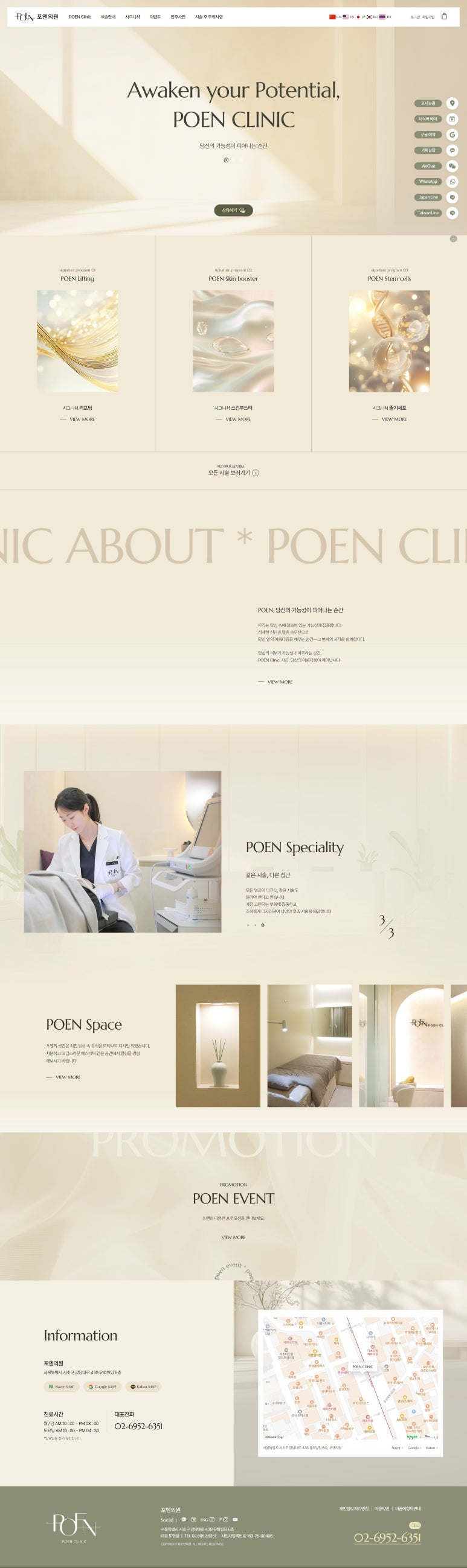
4. To increase advertising efficiency, you must consider repeat visits.
When it comes to dermatological treatments and procedures, people often compare several clinics and visit them again to consider whether to consult, rather than making an immediate decision after viewing a website just once.
Therefore, it is important whether not only first-time visitors but also returning visitors can easily find the information they are looking for.
· Isn't the menu complicated?
· Can major medical treatments be easily found on mobile?
· Is it easy to find previously viewed procedure pages again?
· Are consultation methods such as phone or KakaoTalk immediately visible?
· Is it easy to double-check the medical staff, consultation hours, and location?
If this basic user experience is well-established, visitors who entered through an advertisement can quickly find the information they need even when searching for the hospital name again or revisiting the homepage.
In other words, the creation of a dermatology website requires a structure that considers not only new visitors but also repeat visits and brand memory .
The value of your advertisement increases if you can ensure that a single ad click does not end as a one-time visit but leads to subsequent searches and consultations.
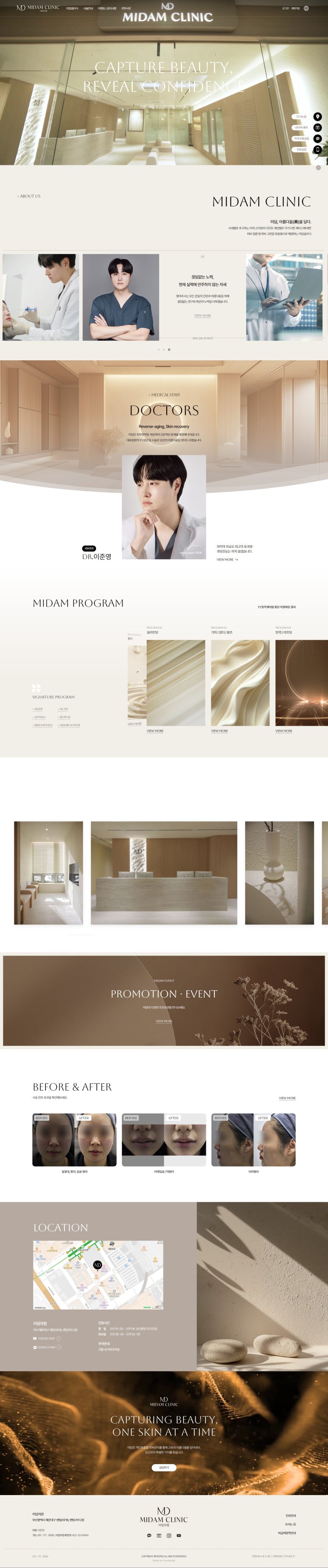
Reducing advertising costs does not mean not advertising.
For dermatology clinics, advertising remains an important marketing tool for quickly acquiring new visitors. Therefore, stopping all advertising does not need to be a realistic goal.
The important thing is to ensure that even with the same advertising budget, the traffic is utilized within the website for a longer period.
Users who arrive via advertisements must verify sufficient information and proceed to a consultation, while the medical content accumulated on the website must be able to generate new traffic through search engines and AI search.
Therefore, if you are creating or renewing a dermatology website, it is recommended to check the following points as well, rather than comparing only the design.
Can ad traffic be converted into actual consultations?
· Can major procedures and treatment content be accumulated as search assets?
· Can you quickly find the information you want on mobile as well?
· Is it easy to use even when visitors return?
· Can search engines and AI understand information about hospitals and procedures?
Once this structure is established, the website can serve as a long-term online asset for the hospital, rather than just a simple advertising landing page.
A well-designed dermatology website considers both advertising efficiency and search traffic.
One of the most realistic ways to reduce the burden of advertising costs is not to run fewer ads unconditionally, but to create a website where ads are not wasted.
A good dermatology website can simultaneously serve as an advertising landing page, hospital introduction, treatment information page, consultation tool, and search content.
Therefore, from the website creation stage, you must connect ad traffic, search traffic, return visits, mobile UX, and consultation conversion into a single flow.
When creating dermatology websites, Cross Design considers not only the simple design but also treatment-specific content, search structure, SEO, GEO, AEO, mobile usability, and the consultation conversion flow.
▼ Inquire about Dermatology Website Creation ▼
https://crossdesign.co.kr/contact/
▼ Cross Design Portfolio ▼
https://crossdesign.co.kr/hompage_portfolio/
▼ Contact GEO Service ▼
https://crossdesign.co.kr/geo-application/
To reduce reliance on advertising on a dermatology website, simply cutting ads is insufficient. It is crucial to create a conversion structure that retains visitors acquired through ads, along with a content structure that allows for continuous discovery through search engines and AI.
